Nain looked out across the flat floor of the valley at the distant light of the other furnaces and frowned. Behind him he could hear the crackling of the clay in his own furnace as the howling flames beat hotter and hotter. He turned back to look at it. As he did, the accursed wind caught his heavily greased hair and flapped it against his face. He slicked it back into a queue and frowned even deeper, fingering the heavy silver plates of his necklace. The morning was not going to be a good one.
The contest had started out as it did every year. Tobol had approached Nain as soon as the last of the monsoon rains had dried, asking him if he planned on entering. As the new village smith, Nain appreciated his father's deference. As village elder, Tobol could have merely ordered it, but instead had approached his son as he might an equal. Nain had replied that he would build his furnace even bigger than the furnace from last year. Tobol was no smith, and had offered no objections. The villagers had been curing the ore all during the monsoon season, and piles of charstone were ready to be shoveled into baskets. Everything seemed to be leading to a great victory. Now that victory seemed in doubt.
Marah ran up to him, her skin glistening with sweat. "Father, the fire is below the top flue. Should we add another charge?" She stood beside him, rubbing her newest tattoo absently. Nain looked down into her upturned face, but had no reply. He looked out into the early morning darkness to avoid her gaze, and was startled to see a figure approaching. His heart sank. It was Jarusalah, the master smith.
The contest was hardly the only time that Nain met with the master smith. The old man had a circuit he traveled continuously, passing from village to village in the red, desert valleys of Thool, on the eastern coast of Mandraka. Jarusalah's title belied his importance. It was his word that set the price for the steel each village would make, and it was his word that called the traders in each year to buy the steel. His word was not disputed, for only he knew the tongue of the seafaring clans, men from such remote places as Baranur and Kimmeron. Without his favor a village would be reduced to digging for jamot roots for food, rather than buying pressed dates from Beinison or salted mutton from Lord Farley's high oasis. He decided disputes betwe en the villages, and had final say over who held what office. The people of Thool had no king: they had a master smith. Nain enjoyed good favor with Jarusalah, and was happy to see him any other time of the year. Now his presence sent dread into Nain's heart.
Nain looked back down at Marah's face, his fingers nervously stroking the necklace that was his badge of office. Although she had only seen ten summers, Marah was wise enough to know that things were not going well. He wondered how she would react when he lost the contest. She had never known anything but unmatched success from him and his work. She had grown up in a world of luxury and prosperity, as had all the children of the village. What would they see now? He adjusted the heavy silver necklace, but still its weight pressed against his collar bones. How did the other smiths bear such weight? Nain didn't think he would ever be comfortable with the burden.
"How goes the burn, Nain?" Jarusalah's voice came from behind him, and Nain turned to face him, genuflecting reflexively. Marah followed his example with a deeper bow of her own, dropping to her knees and touching her wet forehead to the ground.
"Differently," he replied, then turned back to Marah. "Yes, add another charge. Be careful you don't get burned. Wet your head before you go up." She nodded and ran back to the furnace.
"Only one other time have I ever heard such a noise of burning from a furnace, Nain," Jarusalah said.
"Eye of the Sun," Nain replied, nodding, following the older man as he walked down the slope toward Nain's furnace.
"Yes," agreed Jarusalah. "Not that yours is that hot yet, mind you," he added. "I don't think, anyway. You would need to build twice as high and use bellows like no one here has ever seen. But yes," he said, squinting into the glare from the fire, "I think you are too hot."
"It's the wind," replied Nain, looking up at the cold, unmoving stars. "I had not expected this much wind."
"The others are happy for the extra heat," Jarusalah said. "But I think you built just a bit too high this time."
The two men stood a chain or so away from the furnace. It was built up the side of the small hill that Nain's family had used for decades of contests. Nain and his daughters had raised the flue of the furnace higher by a head than the actual top of the cliff. Now the bricks at the top of the flue glowed red in the night. Nain could see where bits of the topmost row had actually eroded away in the intense heat. In his mind's eye Nain could see the ore inside burning away, leaving behind not the normal bloom of sponge iron, but instead a less valuable melt of moon iron.
"I see that Tobol has blessed you with office," Jarusalah said, pointing at the wide silver plates lying across Nain's collarbones.
"Yes," Nain replied, stroking them self-consciously. He fingered the large black and green stones set into the metal plates, noting again the worn runes carved into their polished surfaces. "Bororel has spoken his last."
"He is dead, then?"
"Not dead," Nain replied, glancing up briefly. "Not yet, I don't think. But the poison has finally taken his mind. Father granted me the title and badges to go with the duties."
"You don't wear them well." Nain looked up, stricken, but Jarusalah continued, "But then neither did Bororel, when he first wore them."
Nain relaxed a bit. "No?"
"No. He took his responsibilities seriously also."
Nain considered this for a moment. "One ought to. When our iron is our food, a smith can starve a village."
"Or feed it. And Bororel did. That's why Bororel now has an apprentice as wise and responsible as Nain." Nain looked up at him, but Jarusalah was focused on the furnace. "I assume you have stopped working the bellows."
"Yes, I told the girls to stop pumping a watch ago."
"You could knock down that extra stack," Jarusalah said, pointing upward with his staff.
Nain shook his head, releasing his tense grip on his smith's necklace and straightening his leather apron. "I would, but what you don't see is that the back of the furnace is made with long slabs of stone. If I try to knock the top off, the whole furnace would come down."
"Ah." The two men stood watching as Marah worked the pulleys to dump another charge into the core. A cloud of sparks flew into the air, and the roar of the flame edged up another note. "Have you tapped it yet?"
"No."
"You will need to, you know."
"I wanted to ask ... talk to you first."
Jarusalah nodded. "You are a cautious man, Nain. Very wise of you. But you will need to tap it."
Nain nodded, then turned and cupped his hands to his mouth. "Beelah! Bring water!"
As Jarusalah watched, Nain tossed aside his leather apron and picked up a heavier set of leather clothing, including long leather gloves. The heat of the furnace was almost unbearable where he stood, and he needed to get even closer. His daughter of eight summers waddled up with a bucket filled with water, Nain's youngest tagging along behind. Jarusalah took the bucket from her and held it ready. Nain turned to Beelah as he tied the apron in back. Unlike her older sister, Beelah was quick to earn her tattoos with her eagerness to accept family responsibilities. "Take Talet to your mother and wait for me to come get you. Go now." Beelah nodded, scooped up her baby sister, and ran off into the darkness. Nain looke d up as Marah skidded down the dusty hillside and ran up. "Go get another bucket of water and stand here with Jarusalah. I must tap the furnace, and I may need the water." She also nodded and ran off.
"How much moon iron should I expect?" Nain asked.
"Hard to say," replied Jarusalah. "I have never actually fired a furnace this large myself."
"You mean to say I have exceeded the grasp of the master?" Nain bared his teeth in what was supposed to be a smile, but came out more as a grimace. Under the heavy leather he was beginning to sweat monstrously. The weight of the armor ground the smith's badge into his collarbone, and he pulled it out and let it hang down across his protected chest.
"That is every master's wish, Nain."
"But if all I make is moon iron ..." Nain began.
"Your children will not beg, nor dig roots," Jarusalah finished. "Your village will survive."
Nain looked off into the darkness toward the cistern where Marah's thin figure could barely be seen drawing water. "Even I cannot afford to lose a bloom such as this," he said.
Jarusalah startled him by slapping him on the shoulder. "I know you, Nain, son of Tobol. Your pride is rooted deep within you. Even if you fail, you will not break. Your spirit is not brittle like moon iron. You are much tougher than that." Marah trudged up, the bucket suspended between her bowed legs. Nain looked from one to the other, old man and young girl, then picked up his long iron staff from the dust. He nodded to Jarusalah, who carefully and efficiently doused him with water. Nain turned and approached the furnace.
The roar of the blast and the heat of the fire drove thought out of Nain's head as he approached. He wanted to make the tapping a single, smooth movement, requiring as little time near the furnace as possible. The heat of even a small forge could blister, and this monster made his forge at home seem like a dung fire. Jarusalah had said that it paled compared to the great Eye of the Sun furnace, kindled years ago at the great gathering of tribes in the center of Mandraka's eastern desert, but Nain had never felt such a heat. He rushed at the arch and thrust his pole at the small gate, jamming the chisel point of the staff under it and levering it up.
The furnace was intended to burn the iron ore that Nain and his brethren dug from the hillsides of the valley and convert it to bloom, a mass of iron and slag that could be wrought into useful and clever things. What instead flowed from the now open gate was moon iron, a weaker metal formed when the furnace got too hot and burned the strength from the ore. Blazing a brilliant white-orange, the liquid gushed out into the small trench before the gate. Nain danced away from it as it hissed and popped, throwing droplets of molten iron at his booted feet. As he did so, the pole slipped and the gate fell back down, shutting. Nain ran back to where Jarusalah and Marah stood. He was greeted by a bucket of water tossed in his face.
"You will need to do it again, I fear," Jarusalah said quickly. "From what I see there is much more inside. If you release it now you may still get a small bloom when the wind dies down."
Nain nodded and hefted the iron pole in his right hand. He turned back and rushed at the furnace. The pool of moon iron still glowed before the gate, red encrusted with black. Nain saw that he had somehow reversed the pole, and he spun it around as he approached the furnace, accidentally smacking himself in the chin with the end as he did so. He then leaned in, jammed the pole under the gate, and lifted. Once again the molten iron poured out. Nain could feel it burning his forearms even through the leather gloves, but he held his ground until the flow slackened. Only as it slowed did he lean back, releasing the gate. As he did he switched his grip on the pole, and saw a flash of silver. The smith's necklace, his badge of office, had come loose when he hit himself with the pole. As he watched, it fell directly onto the molten iron.
Nain's skin was screaming, but when he saw the necklace fall he forgot the pain and swung the iron staff down, trying to scoop the precious item back up again. Instead the pole struck the badge and drove it under the surface of the melt. Even as it went under, Nain could see it fall asunder, melting like butter on a roasting lamb. Nain stood for a fleeting moment, aghast. Then he saw that his leather clothing had actually caught fire, and he ran.
By the time he reached Jarusalah, Nain had beaten the flames out, but the edges of the leather were still glowing, and Nain stripped it off. Jarusalah blessed him with a shower of cold water as he dumped the smoking armor on the dusty ground.
"My necklace fell in the iron!" he shouted, immediately regretting his tone and yet still feeling his anger and frustration. "I tried to get it out but it melted!"
Jarusalah shook his head. "This night is evil for you, Nain. Listen." He pointed skywards. Nain listened. The wind was blowing even harder, and now Nain could smell a hint of salt in the air. "The wind blows from the ocean tonight. Your furnace will run even hotter than before now."
"It doesn't matter," Nain said, his shoulders sagging. "It took most of my charstone to charge the furnace the first time; it's so big. Even if I were to start over, I could not fill it full enough to burn a bloom now."
"What will you do?"
Nain looked back toward the cistern. Marah staggered up with a bucket of water, which Nain promptly used to douse the remaining embers on his leather suit. He then dropped the empty bucket on the ground and stood staring into the flames inside the furnace. The villagers had labored all during the rains digging the ore and mining the charstone. He thought about the days and days of hauling the baskets of rock from the mine to the village, of the sennights of roasting the minerals in preparation for this one day. The traders came into the desert only once a year, at the time of the contest. How much money would a puddle of moon iron bring? If he made more bloom later, he would have to brave the dust of the desert and the mercy of the fishing folk to reach the incomprehensible traders of the sea. Nain f elt a touch on his skin and looked down into the upturned face of Marah at his hip. Her wide eyes carried her concern into his heart.
"I will decide."
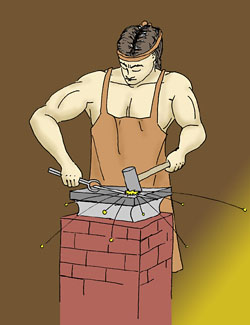
The contest had three parts, each carefully watched by the master smith. First, each village smith would build a furnace. The whole village could help him. Then he would fire it for sponge iron. This started at nightfall and only he and his children could attend it. Then each smith alone had one day to take the sponge and forge a rough blade. The master smith would judge the blades and declare the winner. Not only was the contest a matter of pride, but the victorious village would win the right of first choice of locations to mine that year. It was capricious and arbitrary, but a better way than fighting for the mines, as had been done in centuries past.
By first light, Nain was already working the ingots of moon iron. Inferior in strength to the more ductile bloom, the moon iron was so called because when it snapped, as it almost always did, the broken edges showed gray and pale, like the light of the moon. He had broken the iron into chunks and had carried them to his forge. Now he worked sheepskin bellows with his foot, while with his arms he held the first piece of iron to the flame.
Across the flat valley came the ringing sounds of metal being struck. Nain glanced over his shoulder at the other forge sites. He could see the other smiths working at their own fires, heating and striking. Out of the corner of his eye he saw Tobol coming up, his face neutral.
"Forgive me, father, for not bowing," he said conversationally as the older man approached, "but the iron is hot, and I must work it while I can."
"As you should, as you should," came the reply.
Nain turned the ingot in the fire carefully. "Last night I dropped the smith's necklace. It fell into the fire and was lost."
"So Jarusalah told me."
"Did he also mention that the bloom all burned into moon iron?"
"Yes, he did." Tobol was not a smith, but as a son of a smith in a land of smiths he knew what that meant. "We have had many good years, my son. Perhaps it is time for another village to earn the bragging rights."
Nain blushed at the comforting tone in his father's voice. For decades he had felt the glow of his father's affection and had never truly felt worthy of it. Still, it was good to feel it now.
"They have not earned them yet," he replied with a grunt, lifting the glowing iron from the fire. He dropped it on his anvil and gave it an experimental tap. It tolled dully but did not snap.
"Well," Tobol replied, satisfaction his voice, "I can see you have work to do. I'll go see what my granddaughters are doing."
Nain nodded and struck the iron again. Again it rang but did not dent. He placed the metal back into the fire and worked the bellows. The flame roared. The cold night air was gone, driven away by the heat of his work. Nain waited until he felt the heat of the fire climbing up the tongs, then set the iron back on the anvil and swung. The piece shattered.
When Jarusalah arrived a few menes later, Nain was sitting amid the pile of iron he had made. One by one he was picking up the bits, examining them, and setting them back down. His unattended fire burned a dull red. Jarusalah watched silently for a moment.
"So, will you sell your moon iron to any trader who will take it?"
Nain looked up, his hands still working the piece he held, scratching it with a steel pick. He pursed his lips and stared into the distance, deep in thought.
"If I have any left, yes."
"So you will still compete?" Jarusalah looked at the cooling forge. "The others have already begun the welding. Issaret has nearly completed a bar."
"Issaret is a good smith. I have learned a lot from him," Nain replied. "For instance," he said, setting aside the piece and selecting another, "it was he who taught me how to scratch for steel." He went ahead and did just that, scratching away bits of dross from the chunk in his hand.
"Is there any in your batch?"
Nain shook his head. "No."
There was silence for a while as the older smith watched the younger continue to sort the iron.
Finally Jarusalah spoke again. "Perhaps you might remelt it and cast a blade."
"There is no time, and I haven't the charstone for it," Nain replied. "But my arm is still strong, and the day is new. I will take the best parts, and work it as I can." He looked up unblinkingly at the older smith. "It is what I must do."
Jarusalah nodded. "May the one bless you," he intoned, and walked away.
The sun was fully up above the horizon when Nain shoveled more charstone into his forge and set the next bit of iron into the flame. He did not have as much experience with the moon iron as with bloom iron, but Nain had scratched enough metal to know that not all of his failed melt was composed of the same metal. The pick had shown him that some chunks were less brittle than others, and he had selected these for use. When the iron was hot, he laid it on the anvil and struck it hard. It flattened slightly. He struck it hard, again and again, as if daring it to break. After it had cooled slightly, he thrust it back into the heat, pulling it out when it glowed. Nain worked more cautiously now, but with growing hope. He had tried working moon iron once before, and this was different. With each blow it became more and more obvious tha t this was something new. It was softer, more ductile.
Nain added a second chunk to the flame. Together he beat them, welding the two into one. It went quickly, much more quickly than Nain expected. In fact, the iron was softer even than a normal bloom. He welded more bits to the growing ingot. Soon it was the right size for a blade. Nain traded his heavy hammer for a smaller one, and his blows became more precise. He shaped the iron with joy. By afternoon his arms and legs were trembling from exhaustion, but he had a finished shape. He heated it one last time and quenched the metal in a bath of sheep oil.
Nain drew the dripping blade from the oil and wiped it off on his apron. Instead of the dull gray of moon iron or the darker color of wrought steel, this metal had a silver hue. He rubbed it vigorously, and was surprised to see it take a shine.
"What have you made, Nain?"
He turned. Jarusalah was standing behind him. Nain looked back at the blade. "The moon iron tempered much better than I expected," he said stroking the blade. "I've never even seen a bloom take a shine this quickly."
"It's not moon iron," Jarusalah said, stepping forward, hands outstretched. Nain nodded and handed him the blade. Jarusalah examined it, turning it over, scratching it with an iron ring he wore, tasting it. Finally he spoke. "It was your necklace."
"What?"
"Your necklace." Jarusalah tapped the blade against the anvil and listened to it, damping the vibration with a careful finger run down the rough edge. "It alloyed with the iron somehow." He tapped the blade with a fingernail. "It won't take an edge."
Nain was taken aback. "No?" Jarusalah shook his head silently, still frowning at the blade, and Nain felt a lump rising in his throat. "Am I disqualified, then?"
"No, but you will not be able to win, I don't think." He handed the blade back to Nain. "Issaret is making a fine blade of good iron, and his will hold an edge much better than yours will. But we shall see, eh?" He returned the blade to Nain and walked off.
Nain continued to work the blade, but Jarusalah was right. When Nain began to grind an edge into the iron it just would not take. The metal would not harden. When Jarusalah blew the trumpet to end the contest, Nain knew in his heart that he would lose. He laid the blade on the finely woven cloth he had prepared and carried it to where the festival tents had been erected in the center of the valley.
The other smiths were leaving their forges, followed by their own village elders. Tobol came down from the hillside and joined Nain as he walked. The older man fingered the blade speculatively and glanced curiously at Nain, who just shrugged. They walked silently to the tent where Jarusalah sat, surrounded by traders.
Nain wanted to wait at the back of the small knot of men gathered in the tent, but Jarusalah had other thoughts. As he approached Jarusalah called out. "Nain! Bring your work forward!" Tobol nodded and led Nain to Jarusalah's side. The traders eyed him with interest as he approached the old man. "Give me your blade."
Nain offered and Jarusalah accepted the finished and polished blade, and a quiet gasp arose from the crowd as the light glinted off the blade. Nain smiled ruefully.
"Nain, you have made a beautiful blade in a miraculously short time," Jarusalah said, "but I think at a higher price than you wanted." He lifted a swatch of sheer fabric from a table at his side and slid it across the blade. It slipped cleanly across without catching. Another sigh escaped the crowd, but stopped suddenly when they saw the fabric was still whole. Jarusalah tried again, and this time the fabric snagged a bit on the blade but still did not cut. The master smith tried once more, forcing the cloth against the blade, and it finally tore in two.
"As I thought, your blade looks beautiful, but does not hold an edge." He laid the blade down on the table and looked up. "Issaret." The smith, a thin man half again Nain's age, stood and carried his blade forward. Unlike Nain's offering, his was very rough. It was black and lumpy, with the only hint of polish where the edge had been cut into one side. As proper iron it was hard and tenacious. Issaret had fashioned it just enough to form a rough shape and sharpen it. Jarusalah took it and tested it on a skein of cloth. This time the cloth fell apart with the first stroke. "As you see, Issaret has made proper iron."
One by one the other smiths brought their entries forward. In the end, it was Issaret's that was judged the best. Nain smiled and shouted for him with the others, but his smile was not broad nor his voice free. He watched from the rear as the other smiths hove the victor on their shoulders and carried him away to the feast.
"Jarusalah is not entirely correct," a voice behind him said. Nain turned to see one of the traders step up behind him, carrying the blade Nain had made.
"What?"
"It does hold an edge, of a sort." The trader's accent was very broad, and Nain had to listen to his entire sentence before he was sure he had understood what the man was saying. "And it shines like silver."
"That doesn't surprise me too much," Nain replied ruefully. "You speak our language."
"Yes. My name is Markus. I'm captain of the Singing Mermaid, from Baranur. I've only ever seen a blade like this once before, and that was presented to Lord Clifton, Duke of Dargon, in the north of Baranur. How did you make it?"
Nain looked at his father, shrugged, and turned back to the man. He opened his mouth to speak, but Tobol spoke first.
"We are happy that you like our iron," he said, in a tone reserved for merchants. "Perhaps you would care to join us at the feast? Our house would be pleased to host you."
"Thank you, I will," he answered. "May I bring the blade?"
"Of course." Tobol swept him away, casting a slight smile over his shoulder at Nain.
As evening fell, Nain, Marah, and Beelah were playing an impromptu game of King's Crown, using stones as pieces on a board drawn in the dust. The girls were playing against Nain and were deep in a discussion of what to move next when Jarusalah walked up. Nain stood, as did the girls. Jarusalah motioned them back to their game, seating himself beside Nain.
"Is my father still talking to that merchant from Baranur?" Nain asked the older smith.
"Yes. It seems he wishes to buy your steel for a ceremonial sword."
"How much will he pay?"
"Four Astra."
"What!?" Nain's eyebrows soared. Jarusalah nodded. "So much?" Nain's mind whirled. It was not as much as good iron would bring, but much better than he had dared hope.
"Well, that was for the whole batch. After all, you made quite a bit of that stuff. He's calling it silver-steel."
"Does he know?"
Jarusalah shook his head. "No. And I don't think that what you made was just a result of the silver in the necklace. I will have to remember what stones were set into that necklace. I will test them myself to see what they add to the melt." He reclined onto one elbow, and Nain obligingly lowered himself also. "And of course, your work on the blade made him notice your steel. He would not have bought the raw ingots alone." Nain nodded thoughtfully. They listened to the girls for a moment before Jarusalah continued. "I am naming Jerel second in the contest, with you third."
"Third." Nain kept his voice neutral, but he was pleased to be ranked so high.
"They have chosen the deep mine, and the north mine." Jarusalah watched Nain's expression.
"The deep mine is the best, but I would have expected Jerel to take the black mine. Its ore is richer."
"The black mine is deeper than the deep mine. It is more work to haul the ore up out of it."
"What else do we have to do in the rainy season?"
[an error occurred while processing this directive]Jarusalah nodded. "An answer I would have expected from you." He stood, as did the girls. "It will be a long day tomorrow. I shall retire for the night." He started to go, then turned back. "Oh, and one more thing." He reached around his neck and undid his own necklace, handing it to Nain. "I made that necklace for Bororel, years ago, at the same time I made this one. This should do until you make another."
"But ... only the master smith can make a badge of office. You want me ... ?"
Jarusalah nodded, frowning for a moment. "Well, even I had to learn how to do it once. And I need to teach someone else to do it now. When it's done, bring it to me, and I'll put my seal on it." He turned away. "Goodnight, Nain."
Nain watched him walk away, feeling the weight of the necklace in his hand. He hefted it, looking at it. It felt heavier than his other one, just a bit, but Nain felt he could stand it. He put it on, and went back to the game.